

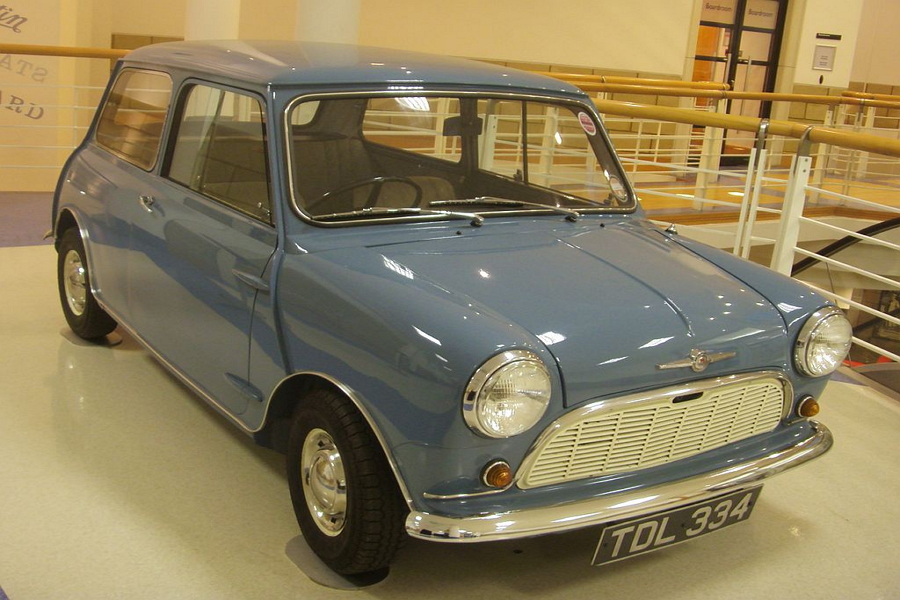
The Mini is a popular car among automotive fans of all ages. The appeal of the Mini has made it one of the most recognisable cars around. The story of the Mini and how it came to be is one filled with mergers, takeovers and resilience.
The iconic Mini was first made by the British Motor Corporation (BMC) in 1959
BMC was once the largest British owned car company and accounted for 39% of all British cars at the time that the Mini was made. BMC was started when Morris Motors Limited owned by William Morris and Austin Motor Company founded by Herbert Austin merged in 1952. William Morris was the first chairman but retired soon after and was replaced by Leonard Lord.

The first Morris Mini-Minor sold in Texas being delivered to a family in Arlington, Texas, in 1959.
The first Mini was the Mini Mark I and was the British equivalent of the German Volkswagen Beetle. The Mark I was classed as a “city car” and was a two door saloon. Underneath the bonnet of the Mark I was an 848cc (.848 litre) straight four A-series engine made by Austin. The small engine only had 33hp and 44 lb-ft of torque but was capable enough to power the small Mark I. It was paired with a 4-speed manual gearbox and front wheel drive. The Mini had a top speed of 74mph and could accelerate to 60mph from a standstill in 27.1 seconds. The Mini was known to be fuel efficient at 43.5 miles per gallon.

The 1963 Austin Mini
The Mini Mark I was successful as it was capable of carrying four passengers in a very compact frame. The Mark I had a two box design which accommodated the four passengers but did not have a third box for the boot. The suspension was designed to use rubber cones as springs since conventional suspension designs would increase the height of the vehicle. The Mini also had a shorter length because the engine was mounted transversely and had front wheel drive. Another innovation was having the engine and gearbox sharing its oil sump. By not having a transmission tunnel running the width of the car, there was enough space to accommodate the rear passengers. The Mini had sliding windows as the side panels were used as a storage place in place of a boot.
The original Mini appeared in several other variants: an estate, a van and a truck.
The popular Mini Cooper appeared in 1961 when John Cooper saw the potential of racing in the small Mini. The tuned engine was slightly bigger at 1 litre and more powerful with 55bhp. The Cooper also had double SU carburetors and 7-inch brakes. The car was designed to meet the Group 2 Rally rules and 1,000 units were made.

A Morris Cooper from 1969. Photographed inside the Dolce Vita shopping in Porto.
The Mark I had an eight-year production run and was eventually replaced by the Mark II. The Mini had a very successful run and was produced in several countries including Australia. The Australian Police even used the Mini Cooper as a plainclothes car. The Mini Cooper was also successful as a rally car which made it very popular.
The British Motor Corporation merged with Jaguar to form the British Motor Holdings in 1966 after some profitability issues. Two years later it merged with Leyland Motor Corporation as the British Leyland Motor Corporation. In 1984, BLMC sold Jaguar to Ford and renamed itself the Rover Group.

Austin Mini Countryman, Brooklands car park,Mar 2009
BMW bought the Rover and Mini marquee in 1994 and sold the Land Rover brand in 2000. The Mini marquee is still owned by the BMW group to this day.
The Mini remains a very popular car to this day. It was even voted as the second most influential car of all time behind the Ford Model T as a testament to its success.
Images via Wikipedia


Leave a reply